


If we had unlimited time, we could talk all day about how we make our instruments and the technology behind and inside our guitars. But we don’t have that time, and that is why we are doing it here: time for some technical chat.
Our passion is building guitars. But describing what you hear and see is harder for us than incorporating these important characteristics into a guitar.
On this page, we specifically want to give you an impression of the characteristics of the guitars we build.
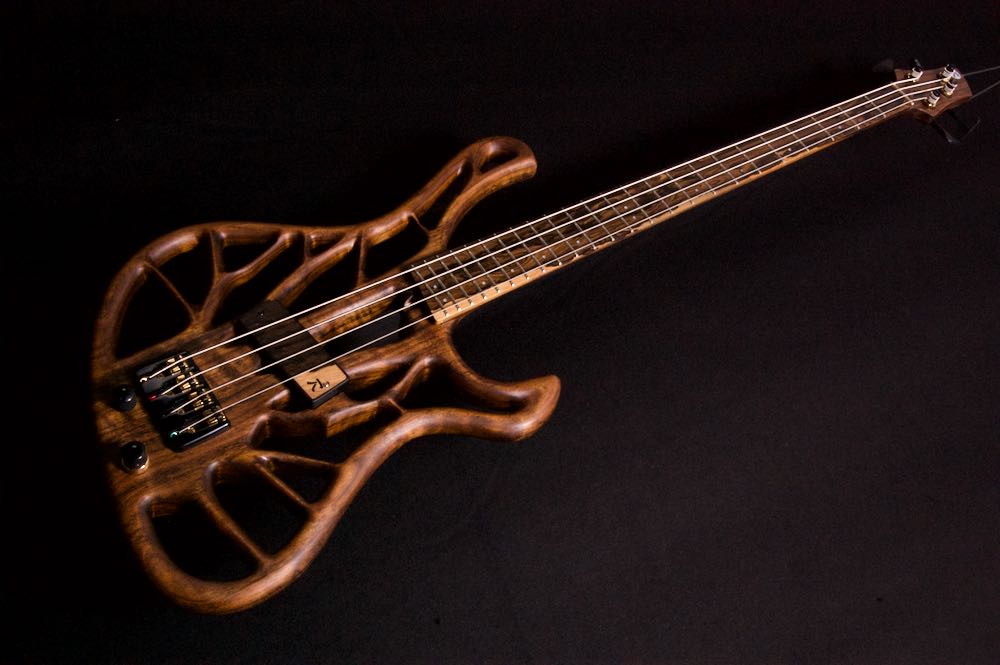
The Treeline-effect
For the Holy Grail Guitar Show in Berlin, we made a ‘see-through’ bass guitar for the first time. Despite the holes, the instrument sounds no worse than a normal bass. We have also applied this effect to the Lignator guitars.
Blind Fretslots
We don not saw all the way through the fingerboard, but stopped 2 mm from the sides. This way, you don’t see the ends of the frets. However, this is not just an aesthetic feature: it makes the fingerboard much stiffer. A stiff neck improves the directness and responsiveness of your sound. It also prevents the frets from sticking out from the side of the fingerboard and cutting your hands while playing.


Fretwire
We use three different types of fret wire for our instruments: nickel silver, EVO gold, and stainless steel. They all have their pros and cons, so there is no right or wrong. It depends on what works best for you as a guitarist.
Nickel-silver is the most common fret wire for guitars. It is a tried and tested material that works well for most guitarists. There are two types, with 12% and 18% nickel. We only use 18% nickel, which is much more durable and suitable for an electric guitar than the softer 12% nickel.
EVO gold sits between nickel-silver and stainless steel in terms of quality. It is harder, more durable, and smoother than nickel-silver, but softer and less stressful for our tools than stainless steel. Additional benefits are the absence of nickel, making it a good choice for people with a nickel allergy, and the gold color.
Stainless steel is the hardest and most durable option of the three. It lasts (almost) forever, and bending it feels very smooth and easy. However, it does add a bit more clarity/sharpness to your sound. At high gain and with lower-tuned instruments, the difference is very subtle and even pleasant for some, but especially when playing clean, some people do not like the clarity. A major disadvantage of stainless steel is how heavy it is on your tools and elbows; it really takes some effort, but it can certainly be worth the trouble!
Pickups
The pickups are a very important part of an electric guitar. Naturally, they are necessary to convert the vibrations of the strings into sound that comes out of an amplifier, but they also give you the opportunity to color the guitar’s sound to your own taste. For example, by combining a pickup with a bright tone with woods that produce a dark tone.
We prefer hand-wound pickups. Manually winding a pickup results in a ‘scatter wound’ coil. This means that the wire is not wound perfectly and consistently, but exhibits imperfections. These imperfections allow more air into the coil, which ultimately results in a pickup with a more complex sound.
For the Lignator guitars, we have chosen Bare Knuckle Pickups as our primary option. They offer a wide range of pickups, and the different timbres give you the opportunity to truly personalize the tone of your instrument.


Luminlay Sidedots
All Lignator guitars feature Luminlay or custom glow-in-the-dark side dots. On a modern, stage-worthy guitar, you shouldn’t have any trouble finding your spot on the fretboard in a dark room. All you need to make them light up is a quick charge with a flashlight (preferably blue) or some daylight!
Switches & Pots
We always use robust and reliable components and materials. That is why we choose CTS potentiometers, Schaller or Switchcraft switches, and Switchcraft output connectors.


Multiscale Frets
A guitar with a multiscale design combines different scale lengths. Generally, the bass strings have a longer scale length and the treble strings a shorter one. The longer scale length provides more tension, allowing you to tune lower, maintain a tight and defined sound, and help the strings stay in tune better. The shorter scale length for the treble strings makes them slightly looser, resulting in a less shrill sound and making it easier to play solos.
In addition to string tension, ergonomics is an important advantage of multiscale. Your hand naturally moves in an arc that follows the fan of frets on a multiscale. There is always one straight fret, the vertical fret. The position of this fret determines the angle between the bridge and the nut.
We currently have two standard multiscale options: 25.5″ to 26.5″ for 6-string guitars and 25.5″ to 27″ for 7-string guitars. We have chosen the 7th fret as the perpendicular position. This keeps the angle at the nut less extreme, making barre chords relatively familiar and easier to play.
Hardware
All Lignator guitars come standard with Hipshot locking tuners and bridges. Hipshot has been a popular choice for years and has proven to deliver stable, reliable, and high-quality components. Furthermore, their range of bridges is suitable for all kinds of multiscale configurations.


Round Neck Joint
Round Neck Jointis a rare and technically challenging construction method that breaks with traditional rectangular or dovetail joints. Whereas most guitars have a flat or slightly sloping “heel” where the neck meets the body, at Rikkers Guitars this joint is fully cylindrical design. Making a round joint requires a precision that is almost impossible to match by hand. The “pocket” in the body and the “tenon” (the part of the neck that fits into it) must have exactly the same radius.
- Full contact: Because the joint is round, there is a perfect fit across the entire surface. This maximizes the transfer of vibrations between the neck and the body, which benefits sustain and resonance.
- Self-centering: A round connection naturally centers itself much better than a traditional rectangular pocket.
- No “heel”: Because the joint is round and flows smoothly into the body, the transition to the highest positions feels natural. There is no thick block of wood getting in the way of the thumb or palm of the hand.
Rikkers Gitaarbouw uses the Round Neckjoint in the Lignator and Hybridline guitars.
Hals Profiel
The neck profile of a guitar is of crucial importance for the overall feel and playability. Because Lignator guitars are primarily aimed at modern/progressive metal guitarists, we have chosen a comfortable, thin D-shaped neck profile. The D-shape creates a slightly flatter surface on the back of the neck, which is ideal when playing with your thumb behind the neck (classical position). On a very round surface, your thumb keeps searching for the correct perpendicular position. The flatter surface creates a comfortable position for your thumb.
Custom Neck Profile
With almost every Rikkers instrument, you can choose your own neck profile. You can provide measurements and preferences, but we are also happy to measure a favorite neck of yours to incorporate into your new guitar. Customizing is standard at Rikkers Guitar Building.


Nut
A good nut is crucial for the playability, sound, and performance of your guitar. We devote a great deal of time to crafting our nuts to the best of our ability and use only high-quality materials. Our preferred materials are bone, bell brass, and Lignum Vitae.
Bone has long been one of the most widely used materials for nutboards on instruments, and not without reason! It is a hard and dense material with good tonal properties, resonance, precise tuning, and high durability.
If you want to give your open strings a bit more bite, bell brass is an excellent option. A brass nut ensures that your open strings sound almost exactly like your fretted strings. Moreover, brass is a very durable and wear-resistant material.
Something special that we have recently started using for our instruments is Lignum Vitae. A type of wood with a very high density and self-smoking properties. This wood is also used for bearings in windmills… as if that weren’t enough!
Neck Wood Combinations
We like to use layered necks for our guitars. Not only because of the very attractive appearance, but also because of the structural advantages. The use of multiple types of wood makes the neck more stable and stiffer, reduces the risk of warping or twisting, can minimize the chance of dull tones, and makes it possible to create a more even tone or to color the sound as desired.


Quarter-sawn Necks
Voor onze halzen gebruiken we bij voorkeur kwartiersgezaagd hout. Kwartiersgezaagd is een term die een specifieke zaagmethode beschrijft. Zoals op de afbeelding te zien is, zorgt deze methode voor een verticale houtnerf. Deze rechte nerf maakt de hals extra stabiel en stijf. Bij het maken van een meerlaagse hals zorgen we er bovendien voor dat de stukken kwartiersgezaagd hout gespiegeld worden, wat de hals nog stabieler maakt!
Would you like more information about the possibilities for your own Hybridline guitar? Curious about what is within your reach?